


The Numbers Behind the World's Richest Marine Ecosystem
When Conservation International conducted comprehensive biodiversity surveys in Raja Ampat in the early 2000s, the results were so extraordinary that they initially seemed improbable. Scientists documented 1,508 fish species, 699 mollusc species, and 537 coral species in a single archipelago — numbers that represent approximately 75% of all known coral species and more fish species per unit area than anywhere else on the planet.
These are not just impressive statistics. They represent the living, breathing manifestation of fifty million years of evolutionary isolation and the convergence of nutrient-rich currents from three ocean basins at a single geographic point. Raja Ampat sits at the apex of the Coral Triangle — the global epicentre of marine biodiversity — and the results of that privileged position are visible to any diver who descends into these waters.
For DUNE's divers, these numbers translate into an experience that is qualitatively different from any other diving destination. Not just more fish, but more kinds of fish. Not just more coral, but forms and colours of coral that exist nowhere else. Every dive in Raja Ampat has the genuine potential to introduce you to species you have never seen before and may never see again outside these waters.
The Science of the Coral Triangle
The Coral Triangle is a roughly triangular area of tropical ocean bounded by Indonesia, Malaysia, the Philippines, Papua New Guinea, the Solomon Islands, and Timor-Leste. This region covers 5.7 million square kilometres of ocean and contains the highest diversity of coral reef organisms on Earth.
Raja Ampat sits at the western vertex of this triangle, where the influence of the Pacific Ocean, the Indian Ocean, and the Banda Sea creates a complex pattern of currents, upwellings, and mixing zones. This oceanographic complexity means that different parts of the Raja Ampat archipelago have very different water characteristics, temperature regimes, and prey availability — and marine life has adapted to exploit every one of these niches.
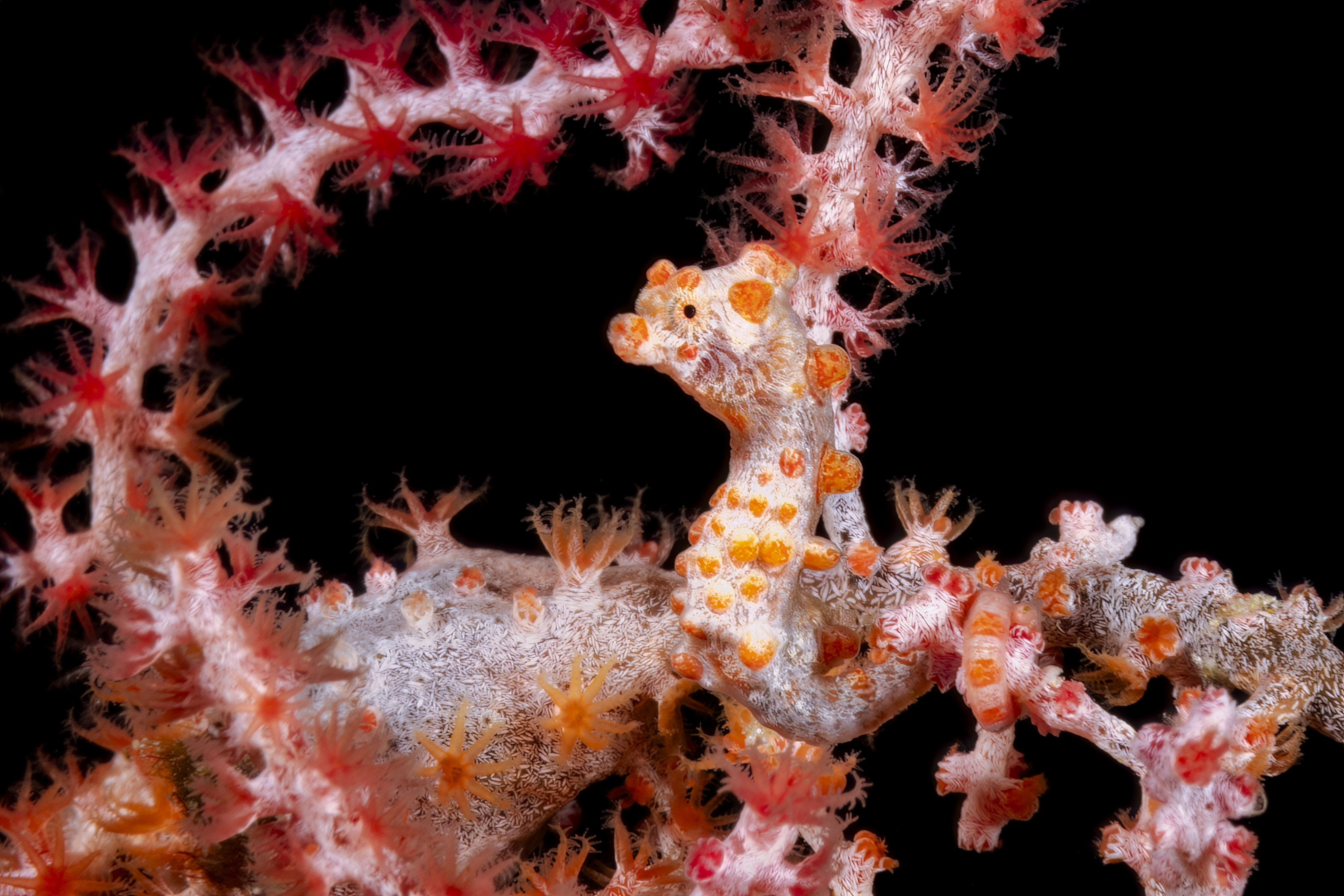
The archipelago also benefits from its relative isolation, which has allowed endemic species — found nowhere else on Earth — to evolve and persist. Several species of pygmy seahorse were first described from Raja Ampat specimens. The walking shark (Hemiscyllium galei), which hauls itself across reef flats on its pectoral fins, was first documented here.
Fish Species That Define Raja Ampat
The fish communities of Raja Ampat represent the full spectrum of Indo-Pacific diversity compressed into a single archipelago. Anthias clouds every reef structure in fluorescent pinks, oranges, and yellows. Napoleon wrasse — among the most intelligent and long-lived of all reef fish — cruise the reef edges with an almost regal bearing. Bumphead parrotfish gather in schools of fifty to a hundred individuals, their ram feeding on coral creating an audible crunching that carries through the water.
- Napoleon wrasse (Cheilinus undulatus) — up to 2 metres, remarkable intelligence
- Bumphead parrotfish — coral-consuming schools, particularly at Cape Kri
- Reef mantas — year-round presence at cleaning stations
- Wobbegong sharks — camouflaged ambush predators on reef substrate
- Epaulette sharks — walking sharks unique to the Bird's Head region
- Banggai cardinalfish — bright and unmistakable in sea anemones
- Pigmy seahorses — four species documented, all on sea fans
Coral Diversity: The Foundation of Everything
With 537 documented coral species, Raja Ampat's reefs are structures of almost incomprehensible complexity. Hard corals form the architectural framework — massive brain corals, plate corals extending like underwater dinner tables, and branching staghorn formations that create miniature forests sheltering thousands of fish. Soft corals add the palette: sea fans in deep reds and purples, dendronephthya soft corals in pinks and yellows that seem to glow in the ambient light.
What is perhaps most striking is the health of these corals relative to reef systems elsewhere in the world. While global coral bleaching events have devastated reefs from the Great Barrier Reef to the Maldives, Raja Ampat's deepest and most nutrient-rich reefs have shown remarkable resilience. The cold upwellings that sweep through the archipelago's channels help buffer against the temperature extremes that trigger bleaching, and the strong community conservation ethic here has reduced the human pressures that compound the effects of climate change.
Invertebrate Wonders
Raja Ampat's invertebrate community rivals the fish life in diversity and spectacle. Nudibranchs — sea slugs — reach their greatest diversity in Indonesian waters, and Raja Ampat is home to species found nowhere else. The Spanish dancer, among the largest nudibranchs in the world, performs its extraordinary undulating swimming display at night. Flamboyant cuttlefish hunt along sandy bottoms, their skin rippling with colour changes that outperform any artificial display system ever created.
Giant clams — some over a metre across and decades old — anchor themselves to coral rubble and filter-feed in the shallow lagoons. Mantis shrimp, armed with the most powerful appendage per body weight of any animal on Earth, excavate burrows in sandy patches. Decorator crabs festoon themselves with living coral and sponge fragments, creating mobile gardens that move slowly across the reef.
Why This Biodiversity Matters for Conservation
Raja Ampat is not just a diving destination — it is a global conservation priority of the highest order. The marine protected area network established here is one of the most extensive and best-managed in Southeast Asia, covering over 10,000 square kilometres of reef, lagoon, and open water. No-take zones, seasonal closures, and actively patrolled boundaries have dramatically reduced illegal fishing and shark finning operations that once threatened to deplete these extraordinary waters.
The conservation model at Raja Ampat — built on genuine partnership between dive tourism operators, international NGOs, and local communities — is being replicated across Indonesia and the broader Coral Triangle. The lesson it demonstrates is one of profound importance: sustainable dive tourism can generate more economic value from a living reef than destructive fishing ever could.
DUNE is proud to support this conservation work through our partnership with the Raja Ampat Biosphere Reserve Foundation and through the environmental operating standards we require of all our partner liveaboard operators.
Experience Raja Ampat's Biodiversity with DUNE
A DUNE Raja Ampat expedition is not simply a diving holiday — it is an encounter with the living apex of marine evolution. Our marine biologist guides bring the science of the reef to life during daily briefings and help you understand the ecological relationships behind the spectacle you witness on every dive.
Contact DUNE to discover our current Raja Ampat programme, designed for divers who want not just to see the world's finest reef system but to understand it. Places on our small-group expeditions are limited — enquire today to secure your position.